A charming and unexpectedly funny biopic on the frantic and eccentric life of Alberto Giacometti (Geoffrey Rush) doesn't shy away from the darker and sadder aspects of the artist's character. The film revolves around Giacometti painting the portrait of American writer James King (Armie Hammer) and the toll painting and sculpting has taken on the once beaming and confident artist.
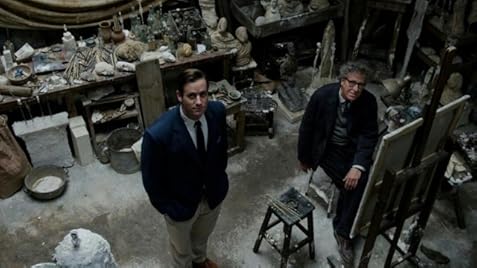
The colour palette of the film is simple. Blue, white, black, grey and some yellows illustrate the world through Giacometti's eyes, as these were colours so often utilised in his art work. In fact Giacometti often muses on his struggles and his ultimate failure to illustrate the image he sees, whilst we watch this world through James King's eyes.
King isn't much of a character himself. What we know is he's gay, a writer and not much else other than that he is super-humanly intrigued into this tortured artist, to the point where he continues to stay and have his portrait painted, cancelling plans over and over. Despite this, Armie Hammer puts on a good performance as what is essentially a blank canvas for the viewer to project their own feelings onto. When King expresses surprise at one of Giacometti's quirks or actions, the audience does too. In Final Portrait, Stanley Tucci, the writer-director, deftly turns King into an actual character this way, rather than simply being a cinematic device.
Elsewhere Tucci's direction is visually interesting enough to keep the audience invested at times when things that are, quite simply, profoundly boring, are taking place on screen. Most importantly, the painting scenes. Who wants to sit around for 90 minutes watching someone paint someone else? Of course this is not the whole movie, but a significant portion of time is dedicated to the painting (and rightly so.) Tucci manages to keep these scenes visually interesting enough. And enough is good, when a film is paced as well as Final Portrait.
The central performance from Geoffrey Rush is just superb. Whenever he is on screen he elevates the movie. Everything from the delivery of his heavily accented "Oh fuck!" to his mannerisms and expressions when we are first introduced to him in a scene with no dialogue. Rush manages to frame Giacometti's character in only a few minutes of smoking and sculpture moulding, and from there we see him unravel and put himself back together hundreds of times.
Despite these strong aspects, a biopic has to delve beyond a simple biography of someone, and although Final Portrait is inventive in how it does this, it fails to express the central ideas and conflicts in the film with enough clarity. Although it certainly does explore the ideas of endings, definiteness and artistic integrity a lot, it is just missing something. The themes are confused and overlapping, and perhaps lacking definiteness. Of course, that is in itself a major theme in the movie - definiteness. And although it is explored and discussed visually and verbally, sadly Final Portrait does not quite strike a chord over this, and perhaps it is on purpose. Of course this is what Giacometti struggles with in the film, and it may be deliberate to not explore the subtext and underlying conflict of the film to a greater degree.
Nonetheless it was a vastly enjoyable picture about a lesser known artist that will leave you with a smile on your face, without a doubt. Despite it's failure to nail the themes, they are still utilised and explored to a healthy degree, Armie Hammer and the brilliant Geoffrey Rush bring it on home for a solid biopic that truly gives you a look into the world of a troubled artist. Whether you are laughing at Giacometti's ruthless verbal take down of Picasso, or concerned with how he is coping with his ongoing artistic self-torture, Final Portrait will leave you pleasantly surprised, and completely charmed.

No comments:
Post a Comment