Blade Runner 2049
★★★★½
"And blood-black nothingness began to spin, a system of cells interlinked within cells interlinked within cells interlinked..."

When a great film of days gone by is rebooted, or given a sequel, there is always, and rightfully so, a sense of trepidation. But when one of the best genre films of all time (as well as single-handedly creating its own sub-genre) gets a sequel, the fear of failure is amplified. Blade Runner was a box office flop - taking $33 Million while needing $56 million to break even. Despite this it garnered a cult following for its inventiveness, world building and entirely new take on the sci-fi genre. After 4 different cuts, the last of which was in 2007, there was rarely any talk of a sequel. Nonetheless 25 years later, and approaching the actual year of 2019 in which the first Blade Runner is set, a sequel was greenlit, and found its way to the big screen.

While Blade Runner took a very simple plot (some replicants are here, hunt them down, Deckard.) in a vast and complex world, 2049 goes further, as Officer K (the fantastic Ryan Gosling) discovers something that according to Lt. Joshi (Robin Wright) "Breaks the world". And so he sets off on a vast and expansive mystery and at last we get a feel for the enormousness of what makes up the Blade Runner society. BR2049's world building is spectacular. Entirely confined with dystopian California, we learn of the events in the 30 years preceding this story, as well as how the country is sustained across its different regions. We travel with K across California and experience the true vastness and implications of the result of the mystery on countless people. By getting a comprehensive look at Blade Runner society in 2049 we learn and become more personal with the stakes of the mystery, as well as learning more about K along the way.
Ryan Gosling delivers yet another standout performance. Fantastic in La La Land, The Big Short, Drive, The Nice Guys, Gosling takes another wicket as the tortured Blade Runner Officer K, and captures your heart through his tragic relatioship with a hologram - Joi. Their struggle together appears unique, and as Joi tells him at one point - special - but K is surrounded by images of the commercialisation of Joi as a hologram, as a product. Gosling's excellence is largely due to his great ability in bringing every corner of his character alive. While he's with Joi you can see his dual torture and acceptance of Joi's lack of physicality.

While Armas (Joi) doesn't have this duality, her descent into desperation is very convincing, especially considering in many of her scenes she won't have been shot opposite Ryan Gosling. Goslings acting also comes alive as we go through the second and third acts, as his character dives deeper into this mystery, where he is stretched to his breaking point. Two standout scenes are the baseline tests, where a rising score, combined with the inflection and vigour of Gosling's voice and piercing stare make for a supremely tense scene.
Elsewhere Harrison Ford looks like he gives a shit for the first time in years. Perhaps he's finally found something he cares about. Deckard returns after going on the run in the time since 2019. The scene in which K and Deckard finally meet is one of the best of the year, set against the orange hue of Blade Runner Las Vegas.

Director of Photography Roger Deakins absolutely nails this setting, and is the standout of the film. Blade Runner LV is drowned in orange smoke, whilst Los Angeles is a neon dystopia. Every shot is measured, whether flying above the sprawl or confronting a group of savages, BR2049 is a beautifully shot film. Across these three aspects, controlling the sizeable budget against Deakins' lavish cinematography, motivating Harrison Ford to actually work while perfecting Gosling's performance, and top tier world building, makes this Denis Villeneueve's best direction of a project for years. Blade Runner 2049 was such an enormous task, so I believe Villeneueve's direction is better than in that of Arrival or Sicario, even if they are close to equal as pictures.
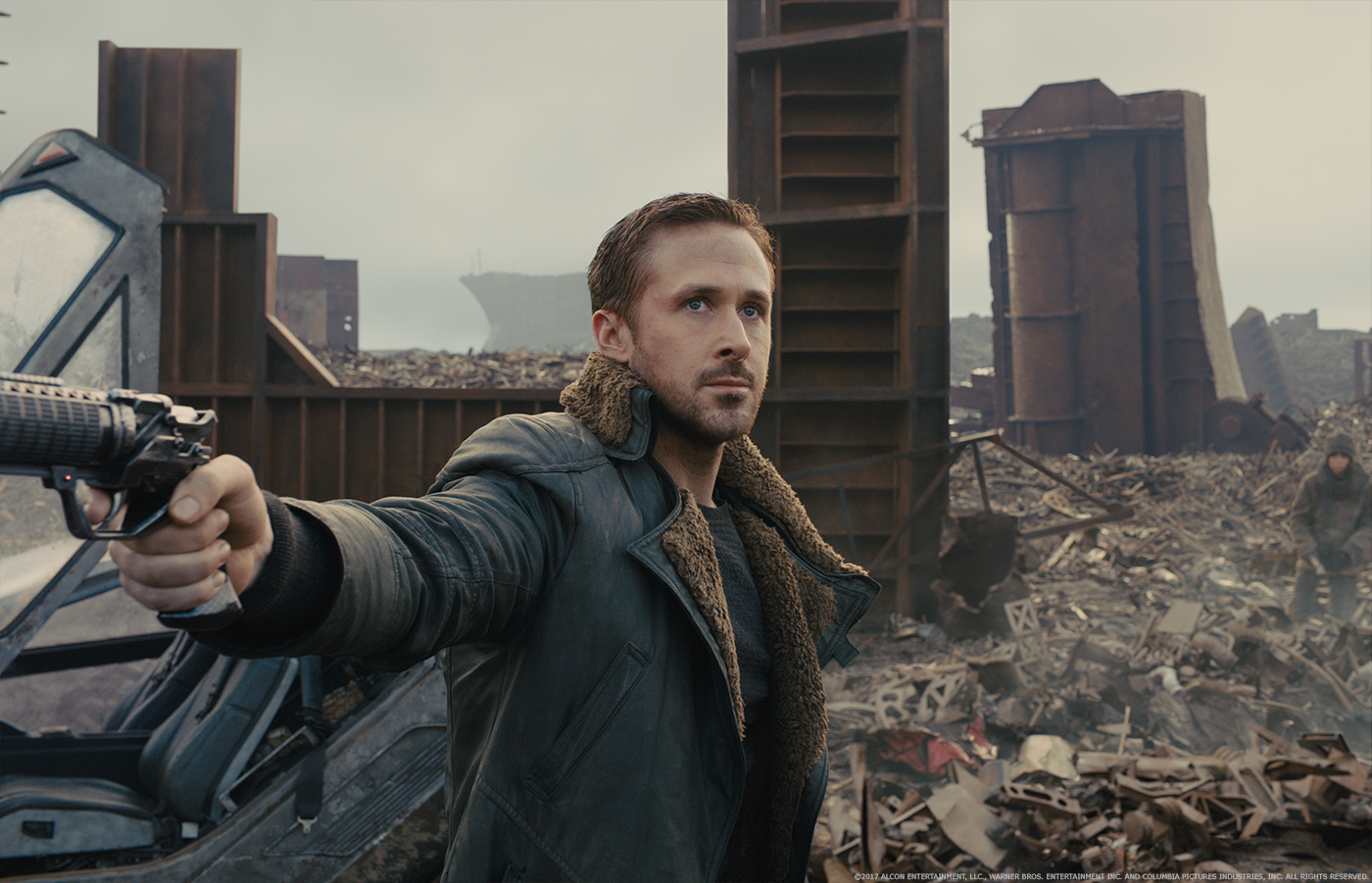
Blade Runner 2049 is everything the sequel to Blade Runner should have been and more. It is a high concept sci-fi study into dystopian commercialisation, the struggle of masculinity and the struggle of femininity, as well as asking that age old Blade Runner question, what does it mean to be human? I'll be doing a proper thematic analysis another time, but for today we can stick with Ridley Scott's vision being continued. Villeneueve has ensured with BR2049 that the Blade Runner legacy will not be lost, like tears in the rain.

Good Time is a panic attack of a movie, that grabs you by the hair and thrusts you into a frantic scramble as you watch Robert Pattinson sprint the streets of New York, sinking further and further into desperation as he tries to get his brother out of jail by the end of the night. Driven forwards by snappy direction and camera work, Good Time is one of the most thrilling films of the year.
It's a simple film really. We open with a big wide shot of New York City, and this is the director telling you this is where we're going to be, take a good long look at it because this is the last time you'll see it in any positive light. Then a series of events leads to Connie Nikas' (Robert Pattinson) brother Nick get landed in jail. Nick is mentally disabled and Connie is convinced he won't survive in prison, tries to rustle up the bail money. Even in the opening moments of the film it is driven forward by a pulsating techno-synth score, which pounds harder than your heart a the Connie stands in a bank mid-heist.

The direction is also excellent from the Safdie Brothers, of whom, Ben plays Nick Nikas. The camera work is claustrophobic, often coming in for tighter shots, but also dissassociative, as in the final sequence. Rather than slow motion and CGI our expectations of how objects are treated are subverted - what's most important we know anyway, and special attention is given to what is seemingly meaningless. This keeps us on edge, and that score is still pulsing away, with all the synths this side of the Hudson.

Pattinson is brilliant as he slips further and further into his desperation. You get the sense that this race against time is well and truly on, and as the night continues, his schemes and journey become so twisted and absurd that at times he can't believe what's happening to himself. It's a thoroughly New York film, but not the New York of Hollywood. The glitz and glamour are gone, this isn't Friends. This isn't The Devil Wears Prada or Now You See Me. This is Robert Pattinson tackling a security guard and filling his mouth with hallucinogens. It's got a real sense of place and purpose, in a film filled with characters with no direction at all. It's one of the most intense thrill rides of the year, laced with tragedy and comedy, Good Time was great.
While Blade Runner took a very simple plot (some replicants are here, hunt them down, Deckard.) in a vast and complex world, 2049 goes further, as Officer K (the fantastic Ryan Gosling) discovers something that according to Lt. Joshi (Robin Wright) "Breaks the world". And so he sets off on a vast and expansive mystery and at last we get a feel for the enormousness of what makes up the Blade Runner society. BR2049's world building is spectacular. Entirely confined with dystopian California, we learn of the events in the 30 years preceding this story, as well as how the country is sustained across its different regions. We travel with K across California and experience the true vastness and implications of the result of the mystery on countless people. By getting a comprehensive look at Blade Runner society in 2049 we learn and become more personal with the stakes of the mystery, as well as learning more about K along the way.
Ryan Gosling delivers yet another standout performance. Fantastic in La La Land, The Big Short, Drive, The Nice Guys, Gosling takes another wicket as the tortured Blade Runner Officer K, and captures your heart through his tragic relatioship with a hologram - Joi. Their struggle together appears unique, and as Joi tells him at one point - special - but K is surrounded by images of the commercialisation of Joi as a hologram, as a product. Gosling's excellence is largely due to his great ability in bringing every corner of his character alive. While he's with Joi you can see his dual torture and acceptance of Joi's lack of physicality.
While Armas (Joi) doesn't have this duality, her descent into desperation is very convincing, especially considering in many of her scenes she won't have been shot opposite Ryan Gosling. Goslings acting also comes alive as we go through the second and third acts, as his character dives deeper into this mystery, where he is stretched to his breaking point. Two standout scenes are the baseline tests, where a rising score, combined with the inflection and vigour of Gosling's voice and piercing stare make for a supremely tense scene.
Elsewhere Harrison Ford looks like he gives a shit for the first time in years. Perhaps he's finally found something he cares about. Deckard returns after going on the run in the time since 2019. The scene in which K and Deckard finally meet is one of the best of the year, set against the orange hue of Blade Runner Las Vegas.
Director of Photography Roger Deakins absolutely nails this setting, and is the standout of the film. Blade Runner LV is drowned in orange smoke, whilst Los Angeles is a neon dystopia. Every shot is measured, whether flying above the sprawl or confronting a group of savages, BR2049 is a beautifully shot film. Across these three aspects, controlling the sizeable budget against Deakins' lavish cinematography, motivating Harrison Ford to actually work while perfecting Gosling's performance, and top tier world building, makes this Denis Villeneueve's best direction of a project for years. Blade Runner 2049 was such an enormous task, so I believe Villeneueve's direction is better than in that of Arrival or Sicario, even if they are close to equal as pictures.
Blade Runner 2049 is everything the sequel to Blade Runner should have been and more. It is a high concept sci-fi study into dystopian commercialisation, the struggle of masculinity and the struggle of femininity, as well as asking that age old Blade Runner question, what does it mean to be human? I'll be doing a proper thematic analysis another time, but for today we can stick with Ridley Scott's vision being continued. Villeneueve has ensured with BR2049 that the Blade Runner legacy will not be lost, like tears in the rain.
Good Time
★★★★
"Don't be confused it'll just make things harder for me."
It's a simple film really. We open with a big wide shot of New York City, and this is the director telling you this is where we're going to be, take a good long look at it because this is the last time you'll see it in any positive light. Then a series of events leads to Connie Nikas' (Robert Pattinson) brother Nick get landed in jail. Nick is mentally disabled and Connie is convinced he won't survive in prison, tries to rustle up the bail money. Even in the opening moments of the film it is driven forward by a pulsating techno-synth score, which pounds harder than your heart a the Connie stands in a bank mid-heist.
The direction is also excellent from the Safdie Brothers, of whom, Ben plays Nick Nikas. The camera work is claustrophobic, often coming in for tighter shots, but also dissassociative, as in the final sequence. Rather than slow motion and CGI our expectations of how objects are treated are subverted - what's most important we know anyway, and special attention is given to what is seemingly meaningless. This keeps us on edge, and that score is still pulsing away, with all the synths this side of the Hudson.
Pattinson is brilliant as he slips further and further into his desperation. You get the sense that this race against time is well and truly on, and as the night continues, his schemes and journey become so twisted and absurd that at times he can't believe what's happening to himself. It's a thoroughly New York film, but not the New York of Hollywood. The glitz and glamour are gone, this isn't Friends. This isn't The Devil Wears Prada or Now You See Me. This is Robert Pattinson tackling a security guard and filling his mouth with hallucinogens. It's got a real sense of place and purpose, in a film filled with characters with no direction at all. It's one of the most intense thrill rides of the year, laced with tragedy and comedy, Good Time was great.